

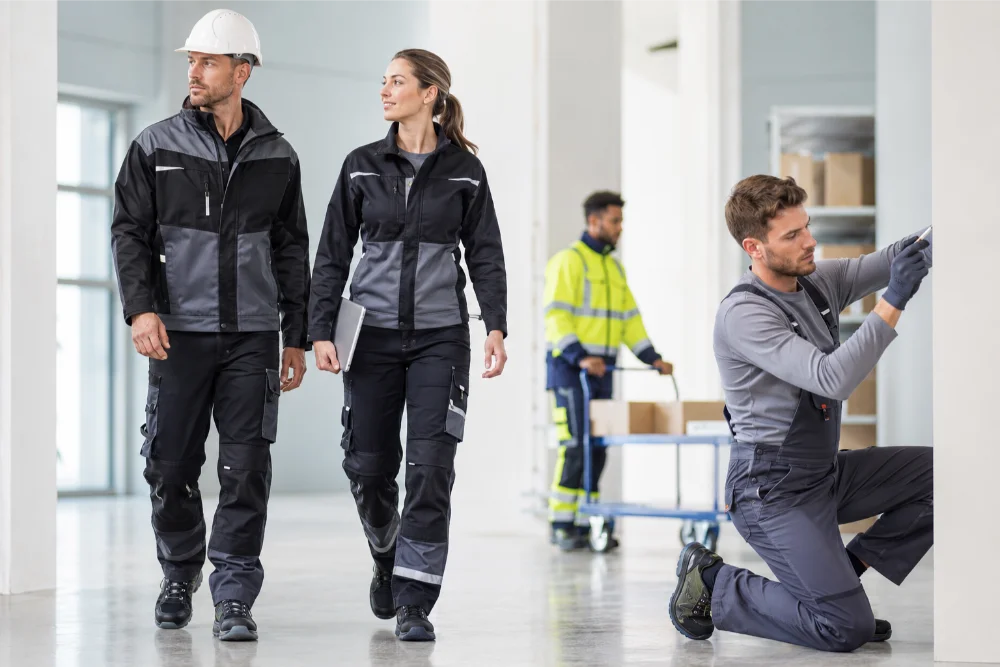
Choosing the Right Workwear
Workwear is not merely about a company’s colours or giving employees a uniform appearance. A properly selected jacket, pair of trousers, or coverall does not restrict movement and protects the wearer from dirt and the environmental conditions associated with a particular job. Requirements differ in warehouses, on construction sites, in workshops, and outdoors. Therefore, the selection process should always begin not with design, but with an assessment of the actual working process.
The real hazards must first be identified: cold, heat, moisture, low visibility, mechanical damage, sparks, or possible contact with chemicals. Ordinary work uniforms and certified protective clothing are not the same thing. If an employee needs protection against a specific risk, thick fabric alone will not be sufficient. The clothing must have the appropriate purpose, labelling, and manufacturer’s instructions.
Size is also an important part of safety. An excessively loose sleeve may become caught in moving machinery, while trousers that are too tight can make squatting, climbing, and prolonged movement difficult. Good workwear follows the shape of the body without restricting it. In practice, it is most useful to try clothing on while adopting working positions: raising the arms, bending over, kneeling, and taking several steps reveal much more than simply standing still in front of a mirror.
Workwear Materials
There is no single universal answer when choosing fabric. Cotton feels pleasant against the skin, absorbs moisture well, and is comfortable for everyday work, although it dries relatively slowly after becoming wet. Polyester retains its shape better, is durable, and dries quickly. Blended fabrics often balance these properties and are therefore widely used in work trousers and jackets. When comparing specific models, it is useful to view workwear according to its intended use, season, and construction, and then adapt the choice to the actual working environment.
Fabric weight alone does not guarantee quality. The seams, reinforcement in high-stress areas, durability of zips and buttons, and positioning of pockets are all important. The knee and elbow areas wear out most quickly, especially when a person frequently leans against hard surfaces. Workwear that is excessively heavy can also become a problem: in hot conditions, it increases fatigue and may encourage workers to remove the clothing or wear it incorrectly.
Comfortable Work Uniforms
Comfort is not a luxury. When clothing rubs against the body, fails to manage perspiration, or constantly pulls tight during movement, attention shifts from the task to the discomfort. In summer, air circulation and moisture management are important, while in winter, layered clothing is essential. Several properly selected layers adapt better to temperature changes than one very heavy jacket, especially when an employee frequently moves between indoor and outdoor areas.
The quality of the design becomes apparent in everyday details. Adjustable cuffs prevent cold air and dust from entering, a high collar protects against wind, and elastic inserts make bending and climbing easier. Clothing may have many pockets, but not every pocket is genuinely useful. Tools should be positioned so that they do not swing around during movement, press against the body while sitting in a vehicle, or become difficult to reach quickly with one hand.
Protective Clothing at Work
A work uniform should only be considered protective equipment when it has been designed to protect against a specific risk and meets the relevant requirements. High-visibility clothing is necessary wherever employees must remain clearly visible around vehicles, machinery, or in poorly lit conditions. Its effectiveness comes not simply from a bright colour, but from the correct combination and positioning of fluorescent material and reflective strips.
When working with fire, sparks, electric arcs, or chemicals, an ordinary general-purpose coverall cannot replace specialised protective clothing. Different hazards require different materials and designs. This is why a risk assessment carried out by the employer is the essential starting point: first the hazard is identified, then the required level of protection is determined, and only after that is the appropriate clothing selected.
Protective properties should not be checked only on the day of purchase. Torn fabric, worn reflective strips, damaged fasteners, or incorrect washing can reduce the level of protection. Employees should know how to put on, inspect, and store their workwear correctly. If one item of protective equipment interferes with another—for example, if a jacket collar prevents a respirator or helmet from fitting properly—the entire protective set should be reviewed.
Caring for Workwear
The first rule of care is simple: always read the label and the manufacturer’s instructions. Excessively high temperatures, strong bleach, or unsuitable chemical cleaning can damage the fabric, protective coating, and reflective elements. Clothing may look clean while no longer performing its original function. Waterproof, flame-resistant, and high-visibility products require especially careful handling.
The frequency of washing depends on the type of work. Dust, oil, and other contaminants should be removed promptly because accumulated dirt damages the fabric and, in some cases, reduces its protective properties. Washing heavily contaminated specialised clothing at home is not always the correct solution. If the substance poses a health risk, organised collection and professional cleaning according to a safe procedure are necessary.
High-quality workwear is rarely the cheapest option, but judging it only by price is a mistake. It is important to consider how long it lasts, how easy it is to wash, whether damaged components can be replaced, and how often an employee requires a new set. The right choice allows a person to work without distraction. The clothing no longer draws attention to itself with every movement—and that is the most accurate sign of true comfort.
